
Scope of MBA in HR: Complete Career Guide, Salary, Skills & Future Opportunities
The Human Resource (HR) profession has transformed significantly over the past decade. HR is no longer limited to hiring employees and managing payroll. Today, HR professionals play a strategic role in business growth, workforce planning, leadership development, employee engagement, and organizational success. This transformation has increased the scope of MBA in HR, making it one of the most valuable management specializations for aspiring business professionals.
An MBA in Human Resource Management (MBA in HR) equips students with the knowledge and practical skills needed to manage an organization's workforce effectively. As companies embrace digital transformation, AI-powered recruitment, remote work, and employee well-being initiatives, the demand for qualified HR professionals continues to rise across industries.
Healthcare is one of the sectors experiencing rapid growth. Institutions such as an IVF Hospital in Ariyalur require skilled HR professionals to recruit healthcare experts, manage workforce planning, ensure regulatory compliance, and support employee development.
This guide explores the scope of MBA in HR, career opportunities, salary, industry trends, required skills, and prospects.
What is an MBA in HR?
An MBA in HR is a postgraduate management degree that focuses on Human Resource Management. The course prepares students to manage recruitment, employee relations, organizational development, compensation, training, leadership, and workplace performance.
The curriculum combines business management principles with modern HR strategies, helping graduates become effective people managers and organizational leaders.
Why is the Scope of MBA in HR Growing?
The modern workplace has changed dramatically over the last few years. Organizations now understand that employees are their greatest asset, making HR one of the most important business functions.
Several factors contribute to the growing scope of MBA in HR:
- Rapid business expansion
- Digital transformation
- AI-powered recruitment
- Remote and hybrid work models
- Employee wellness initiatives
- Leadership development
- Global workforce management
- Diversity, Equity & Inclusion (DEI)
- HR analytics
- Talent retention strategies
These developments have created numerous career opportunities for HR professionals across industries.
MBA in HR Course Highlights
An MBA in HR combines management education with specialized HR knowledge.
Students learn:
- Human Resource Management
- Organizational Behavior
- Recruitment & Selection
- Training & Development
- Performance Management
- Compensation & Benefits
- Labor Laws
- HR Analytics
- Leadership
- Employee Engagement
- Strategic HR Management
- Business Communication
Many institutions also offer internships, live projects, and industry exposure.
Eligibility for MBA in HR
Students generally need:
- Bachelor's degree from a recognized university
- Minimum qualifying marks
- Entrance examination (if applicable)
- Interview or group discussion (depending on the institution)
Eligibility requirements may vary among universities.
Skills Required for a Successful HR Professional
To build a successful HR career, students should develop:
- Communication skills
- Leadership
- Problem-solving
- Decision-making
- Negotiation
- Emotional intelligence
- Conflict resolution
- Analytical thinking
- HR software knowledge
- Business strategy
These skills help professionals manage employees effectively while supporting organizational goals.
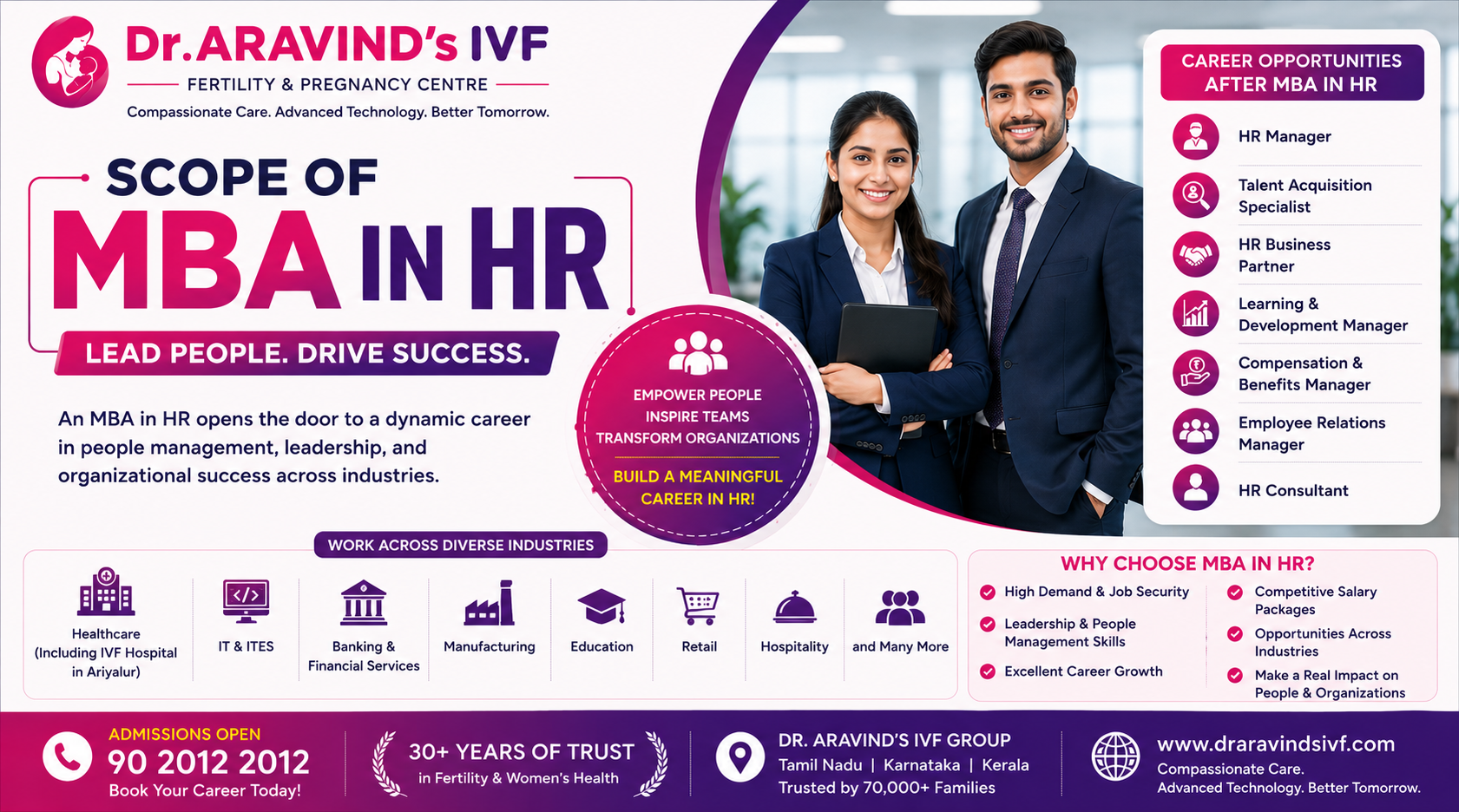
Career Opportunities After MBA in HR
The scope of MBA in HR extends across almost every industry.
Popular job roles include:
HR Manager
Responsible for managing the overall HR department, recruitment, employee engagement, and performance management.
Talent Acquisition Specialist
Focuses on hiring qualified candidates and building a strong workforce.
HR Business Partner
Works closely with business leaders to align HR strategies with company objectives.
Learning & Development Manager
Designs employee training programs to improve productivity and leadership skills.
Compensation & Benefits Manager
Manages salary structures, employee benefits, incentives, and performance rewards.
Employee Relations Manager
Builds positive relationships between employees and management while resolving workplace issues.
HR Consultant
Provides HR advisory services to organizations on recruitment, compliance, and workforce planning.
Scope of MBA in HR in the Healthcare Industry
Healthcare organizations require skilled HR professionals to manage one of the most valuable resources—their people.
At an IVF Hospital in Ariyalur, HR professionals support healthcare operations by:
- Recruiting doctors and specialists
- Hiring embryologists and laboratory professionals
- Managing nursing staff
- Coordinating employee training
- Supporting hospital accreditation
- Ensuring compliance with healthcare regulations
- Improving employee engagement
- Maintaining workforce planning
Efficient HR management contributes to better patient care and organizational success.
Industries That Hire MBA HR Graduates
The scope of MBA in HR is not limited to corporate companies.
Graduates can work in:
- Hospitals
- IT Companies
- Manufacturing Industries
- Banks
- Educational Institutions
- Healthcare Organizations
- Retail Companies
- Hospitality Industry
- Government Organizations
- Startups
- Pharmaceutical Companies
- Consulting Firms
This makes HR one of the most versatile MBA specializations.
Salary After MBA in HR
Salary depends on:
- Experience
- Organization
- Skills
- Location
- Industry
Generally:
- Fresh graduates receive competitive entry-level salaries.
- Mid-level HR professionals enjoy higher salary packages.
- Senior HR Managers and HR Directors earn excellent compensation with leadership responsibilities.
Developing expertise in HR Analytics and Strategic HR Management can further improve earning potential.
Future Scope of MBA in HR
The future of HR is highly promising.
Emerging opportunities include:
- AI-powered Recruitment
- HR Analytics
- Digital HR
- Employee Experience Management
- Workforce Planning
- Talent Intelligence
- Leadership Development
- Organizational Psychology
- Diversity & Inclusion
- Employer Branding
Organizations increasingly seek HR leaders who can combine business knowledge with people management skills.
Latest Trends in Human Resource Management
HR is evolving rapidly through technology.
Current trends include:
Artificial Intelligence in Recruitment
AI helps screen resumes, schedule interviews, and improve recruitment efficiency.
HR Analytics
Data-driven HR decisions improve employee performance and organizational planning.
Hybrid Work Management
HR professionals now manage both remote and office-based teams.
Employee Wellness
Organizations increasingly invest in mental health, wellness programs, and work-life balance.
Digital Learning Platforms
Continuous employee development through online learning has become standard practice.
Diversity, Equity & Inclusion (DEI)
Companies continue building inclusive workplaces through strategic HR initiatives.
Why Choose MBA in HR?
An MBA in HR offers several benefits:
- Excellent career growth
- Leadership opportunities
- High demand across industries
- Competitive salary
- Global career opportunities
- Stable profession
- Diverse career options
- Opportunity to influence organizational success
How to Choose the Best MBA in HR Program
Consider the following before enrolling:
- Accreditation
- Experienced faculty
- Industry-oriented curriculum
- Internship opportunities
- Placement assistance
- Corporate collaborations
- Alumni network
- HR specialization
- Practical exposure
- Career guidance
Conclusion
The scope of MBA in HR continues to expand as organizations recognize the importance of strategic human resource management. From multinational companies to healthcare institutions such as an IVF Hospital in Ariyalur, skilled HR professionals are essential for recruiting talent, developing employees, and supporting organizational growth. With emerging technologies like AI, HR analytics, and digital workforce management reshaping the industry, pursuing an MBA in HR can lead to a rewarding and future-ready career with strong opportunities for professional growth.
(FAQs)
What is the scope of MBA in HR?
The scope of MBA in HR is extensive, with career opportunities in healthcare, IT, banking, manufacturing, education, consulting, retail, and multinational companies.
Is MBA in HR a good career?
Yes. MBA in HR offers excellent job stability, leadership roles, competitive salaries, and long-term career growth.
Which industries hire MBA HR graduates?
Healthcare, IT, banking, education, retail, manufacturing, hospitality, pharmaceuticals, consulting, and government organizations.
Can MBA HR graduates work in hospitals?
Yes. HR professionals are increasingly required in hospitals, including an IVF Hospital in Ariyalur, to manage recruitment, employee engagement, compliance, and workforce planning.
What skills are required for HR professionals?
Communication, leadership, negotiation, emotional intelligence, problem-solving, HR analytics, and strategic thinking.